Career Exploration and Guidance
Audience:
Career counselors, educators, American Job Center staff, job seekers, and students may find this page helpful.
Competency models identify the knowledge, skills, and abilities needed in specific industries or occupations. The tool can be used to analyze an individual's knowledge and skill sets, leading to informed career decisions.
Career exploration may include activities such as performing self-assessments, taking personality and interest inventories, and reviewing information on available careers from job descriptions, workforce information, promotional videos, realistic job previews, and job incumbents.
Career guidance/counseling helps job seekers select a career path, set career goals, obtain appropriate training/education, conduct a job search, complete a job application, write a cover letter and resume, and prepare for a job interview.
Competency models are used in career exploration and guidance activities to:
- identify the knowledge, skills, and abilities needed in an industry or occupation.
- identify individual skill gaps;
- gauge work-readiness in terms of competencies;
- interpret career assessment results so individuals can view their strengths and weaknesses in the context of careers and industries;
- suggest relevant education and training opportunities and credentials;
- help students plan their courses in accordance with industry demands;
- match the skills of graduating students to appropriate industry networks.
Bio1Stop, a workforce development partnership in central New Jersey, is using competency models to help displaced workers evaluate their existing skills, identify gaps, and find the training they need to enter the bioscience field. For employers, the model is a useful tool for articulating their specific skill needs.
Bio1Stop has developed a Job Matching Site that allows applicants to create a personal profile, post resumes, and search for jobs using selection criteria or keywords. The Bioscience Skills Inventory lists important bioscience work activities by specialty. Job applicants check boxes for their skills, which are added to their profiles.
Read more about Bio1Stop here.
Visit the Models in Action to learn about additional ways competency models are being used.
- Students or job seekers interested in a specific industry can use that industry's competency model for career exploration. If your industry does not have a competency model, the Competency Model Clearinghouse provides resources for developing one. For assistance, see the CMC User Guide - Competency Models.
- Use the Gap Analysis with a competency model to identify gaps in skills or knowledge needed in the target industry.
- Analyze the results. Missing competencies can be addressed through education or training.
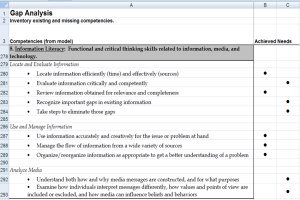
A gap analysis compares the competencies of an individual, group, or organization to those necessary to perform tasks effectively, identifying missing knowledge, skills, or abilities.
To download and use the Gap Analysis worksheet:
- Download from each industry model page. After choosing an industry model, click 'Download' in the Helpline section. You can also download a customized model during 'Stop and Save' in Build a Model.
- Edit the text or column headings as desired; suggested headings are provided.
- Use the worksheet to identify the knowledge, skills, or abilities.
- Analyze the results.
Below is an example of a completed Gap Analysis worksheet: