Identify Credential Competencies
Audience:
Curriculum developers, assessment developers, certifying organizations, license-issuing organizations, corporate trainers, and technical trainers may find this page helpful.
Competency models identify the knowledge, skills, and abilities necessary for success in an occupation or industry. Because of this, models are a resource for developing credentials such as educational diplomas, certificates, and degrees; registered apprenticeship certificates; personnel certifications; or occupational licenses that ensure workers are prepared to face work-related challenges and activities.
A credential is an award to an individual by a third party, with the relevant authority or jurisdiction, as a verification of qualification or competence. Some examples of credentials include:
- educational diplomas, certificates and degrees;
- registered apprenticeship certificates;
- occupational licenses (typically awarded by State government agencies);
- personnel certifications from industry or professional associations; and
- other skill certificates for specific skill sets or competencies within one or more industries or occupations (e.g., writing, leadership, etc.).
Refer to TRAINING AND EMPLOYMENT GUIDANCE LETTER NO. 15-10 for additional information.
Competency models are a useful resource for developing the knowledge, skills, and abilities requirements for a credential. The model provides the basis for identifying and prioritizing content prior to developing specific learning objectives or performance standards.
A competency model can also be used to evaluate an existing credential to determine if the award covers all required competencies. Refer to Communicating Workforce Needs for more information on using models to help employers communicate workforce needs.
The American Hotel and Lodging Educational Institute used competency models to develop the Hospitality Skills Certification (HSC) program. The HSC program is a competency-based certification recognizing employees for knowledge and successful job performance. More info: https://ahlei.servsafebrands.com/training-and-certification-overview.
The Federal Aviation Administration (FAA) maintains a competency-based infrastructure for managers and employees in key occupations. This supports career development, certifications, and licensure programs. Example licensure exam guides for pilots or airmen: https://www.faa.gov/training_testing.
Visit the Models in Action to learn about additional uses of competency models.
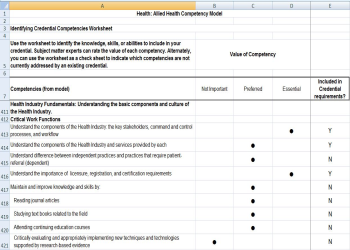
The Identifying Credential Competencies Worksheet allows subject matter experts to provide input on a credential's competencies. Experts can rate importance, identify required competencies, or suggest required levels for knowledge, skills, and abilities.
To download and use the worksheet:
- Download from the industry model page or during 'Stop and Save' in Build a Model.
- Edit the text or column headings as desired.
- Use the worksheet to gather SME input.
- Tally the input – count responses.
- Analyze results.
Below is an example of a completed worksheet: